
Meet Edith Wharton…And Pick One of Her Novels to Read!
This post may contain affiliate links, including Amazon.com. Click here to read my affiliate policy.
Get to know Edith Wharton, one of America’s most famous and treasured authors, with this brief overview of her interesting life, plus find a list of Edith Wharton’s novels and novellas in order of publication.
On January 24, 1862, as the American Civil War raged, one of America’s greatest authors was born in New York City, to a family who had deep roots in the country dating back to the earliest colonial days. Edith Wharton, born Edith Newbold Jones, was destined to become one of America’s leading ladies of literature, but it would take her awhile to get there. Although she had an early interest in writing and storymaking, her parents were reluctant to encourage her. A future profession as an author would be unladylike–and unnecessary–for a society woman.
Edith’s mother, in particular, was hostile to her daughter’s writing interests. Although Edith was allowed to read children’s fiction like Alice in Wonderland, her mother forbade her to read any novels until she was married; a commandment Edith dutifully kept! Edith’s father was apparently more amenable to his daughter’s ambitions. He arranged a private printing of a number of Edith’s poems and translations, and allowed her access to his extensive library of philosophy, history, poetry, and sciences.
Other than her bent towards literature, much of Edith’s early life unfolded exactly as it did for other girls of her social class. She traveled extensively in Europe, was taught by a governess, and came out as a debutante at the age of 17. After two heartbreaks, (and the death of her beloved father) she was finally married to Teddy Wharton in 1885. Teddy Wharton was a friend of Edith’s two older brothers. He was suitably rich, and shared Edith’s love of nature, dogs, and travel.
Edith Wharton’s first major published work was The Decoration of Houses, an interior design manual co-authored with Ogden Codman in 1897. She published her first novella in 1900, when she was almost 40. Her mother died a year later, and from then on Wharton gave free reign to her literary ambitions, publishing over 40 novels, short story collections, and nonfiction books during the second half of her life.
Although Wharton had increasing success as an author, her personal life did not follow the same upward trajectory. Her marriage was under severe strain due to Teddy’s mental instability. To make matters worse, Teddy continually stole money from Edith’s author earnings to maintain a mistress in Boston. The couple divorced in 1913, and Wharton settled permanently in France, only returning to the United States twice more in her life.
During World War I, Wharton worked tirelessly for the war effort, organizing relief efforts for Belgian refugees, opening a sewing workroom for unemployed women, and raising funds for tuberculosis hospitals. She was also one of the few American civilians allowed to travel to the front lines, visiting war-torn villages and the trenches themselves. (Interestingly, one of my favourite mystery writers, Mary Roberts Rinehart, was another civilian who reported from the front lines, although she moved in different circles than Wharton.)
Edith Wharton received three major distinctions in her life. The first was her appointment as Chevalier of the Legion of Honor for her services to France during the war. The second was the Pulitzer Prize in 1921, and the third an honorary Doctorate of Letters from Yale University in 1923. Although her fame continued to increase, Wharton wanted a quieter life after the war ended. She left Paris and set up homes in the northern French countryside and the French Riviera; she divided her time between these residences for the rest of her life. She died of a stroke in 1937 at the age of 75, and was buried at Versailles.
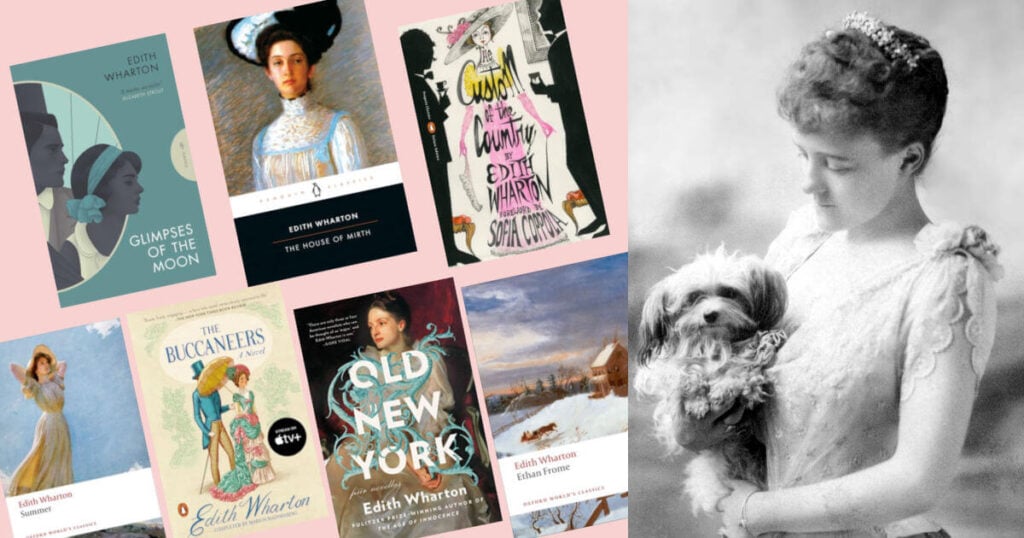
Edith Wharton Novels in Order
Edith Wharton wrote 25 novels and novellas–15 novels and 10 novellas. In an interview she gave a year before her death, Wharton listed her five personal favourites from among her works. They were The Custom of the Country, Summer, The Children, Hudson River Bracketed, and The Gods Arrive.
Although Edith Wharton is sometimes recommended to readers who like Jane Austen, many of her novels do not have the tidy conclusions that Austen’s novels do. In fact, when you read Wharton it’s best to expect to get gut punched by her endings! But if you love Austen’s repartee, nuance, and keen insights into characters responding to the confines of their society, you’ll find all these things in Wharton, too!
You might also have heard Wharton compared to her close friend, Henry James. That’s fair; both wrote psychological “novels of manners” about the leisured class and had close literary and personal ties to Europe. But please don’t call Edith Wharton “a lesser Henry James” as multiple critics have so patronizingly done over the years. Both authors are astounding on their own merits, and in different ways. You’ve never heard someone call F. Scott Fitzgerald “the lesser Edith Wharton,” have you? (Even though he was in awe of her and cited her as a major inspiration.) Alright, moving on. That’s just a literary pet peeve of mine that I’m using my platform to air(;
Enjoy this guide to Edith Wharton novels, with spoiler-free summaries to help you decide which one you’d like to read next. You’ve got to be careful with back-matter summaries and publisher’s descriptions, as some of these really do go too far!
The Touchstone, published 1900
New Yorker Stephen Glennard has recently fallen on hard times, which jeopardizes his plans to marry the beautiful Alexa Trent. But as luck would have it, a solution comes his way: he is in possession of dozens of passionate love letters written to him by a famous author, now deceased. What could be the harm in selling those letters for publication, and investing the money in his future life?
As Wharton’s first published novella, The Touchstone is a simpler book than the intricate novels she’d later become famous for. However, it shows her skill at telling a good story, and explores themes of privacy, betrayal, and the public’s “right” to the personal lives of celebrities–themes very relevant for today. Interestingly enough, the macguffin letters in The Touchstone prefigure a collection of passionate love letters in Wharton’s own life. A few years after publishing The Touchstone, she had an affair and sent her lover many inflammatory letters. When the affair ended, she begged her lover to return the letters. He refused, and the letters have since been published.
The Valley of Decision, 1902
Very different from the rest of Wharton’s oeuvre, The Valley of Decision takes place in Italy in the late 1700s. It traces the coming-of-age of Odo Valsecca, a young duke who must reconcile his Enlightenment ideals with the old-fashioned feudal moorings he grew up in.
Amazon |
Sanctuary, 1903
Edith Wharton’s second novella, Sanctuary explores the inner turmoil of Kate Orme, who discovers that her fiancee has recently made a despicable choice. This leads Kate to a moral crossroads of her own. She sees a path forward that she believes will ameliorate past–and future–wrongs, but it will take a lifetime to achieve.
Amazon |
The House of Mirth, 1905
The House of Mirth is the novel that made Edith Wharton famous. It centers around the heroine Lily Bart, who has almost everything she wants–social standing among New York’s elite, enviable beauty, impeccable manners and taste. She has everything except what she most needs and wants: money. To solve her financial problems, she’s on the hunt for a rich husband, but she’s picky; and at twenty-nine, she’s getting older, too. The novel is a masterful psychological portrait of Lily’s mind and heart amidst her social triumphs and defeats.
Madame de Treymes, 1906
Another novella, Madame de Treymes contrasts the values and ideologies of French aristocrats and wealthy, naïve Americans. Fanny, a once beautiful and free-spirited American woman, has married into the Parisian upper class and become Madame de Malrive. But her life hasn’t turned out as she hoped it would. Fanny is separated from her cheating husband, wanting a divorce but not wanting to lose her son. A childhood friend, John Durham, reenters her life and hopes to “rescue” Fanny, with the help of Fanny’ s sister-in-law and friend, Madame de Treymes.
The Fruit of the Tree, 1907
The Fruit of the Tree is Wharton’s one industrial novel, set in a mill town in Massachusetts. John Amherst is the manager of Hanaford Mill, and desperately wants to improve the difficult conditions of his workers. He’s repeatedly thwarted by the mill owners, who value profit above people. He finds an ally in Justine–a nurse who’s caring for one of his injured workers–and then in a completely unexpected quarter, with Bessy, recently widowed and now owner of the Hanaford Mill. Inevitably, John finds that his projects for industrial reform begin to tangle with his romantic prospects.
Amazon |
Ethan Frome, 1911
Set against the backdrop of a harsh winter in rural Massachusetts, Wharton’s most famous novella is about a man trapped in a life he never wanted: tied to an unprofitable farm, married to a woman he doesn’t love, and powerless to pursue the hopes and plans he made in his youth. It’s a short, bleak novel with a setting deeply tied to its themes of isolation and repression.
The Reef, 1912
A story of Americans living in France, The Reef is about diplomat George Darrow, who reconnects with his former sweetheart after she becomes widowed. On his way to meet her, George encounters a different woman–Sophy Viner–who fascinates him, and the two share a brief romantic affair. Little does George know how Sophy will reenter his life, and what complications he’ll find himself entangled in. The Reef explores the dangerous secrets and passions lurking just beneath the surface calm of social niceties.
The Custom of the Country, 1913
The Custom of the Country features Wharton’s famous antiheroine, Undine Spragg, a young woman from the Midwest who arrives in New York City with money, beauty, and high ambitions to climb the social ladder, by whatever means necessary. The book is an excellent example of one of Wharton’s favourite themes: the contrast between the established “Old Money” elites and the ascendency of the nouveau riche.
Related: Find more famous literary antiheroes and antiheroines here.
Summer, 1917
Set in the same region of New England as Ethan Frome–but in the opposite season–Wharton called Summer “the hot Ethan” for its similar themes of thwarted dreams and the protagonists being tied down to a place they want to leave. Charity Royall wants nothing more than to shake off her dull life in North Dormer, and when she meets visiting architect Lucius Harney, she believes she may have found her ticket to a better life–one that includes plenty of romance, too! A short, beautiful, surprising novel.
The Marne, 1918
Named after the Marne river, where critical World War I battles took place, this novella echoes Wharton’s own frustration over the American attitudes towards the war and towards France. Troy Belknap, an American boy, looks forward to his yearly visits to France, falling deeply in love with the country and its history. When the Germans invade, Troy’s beloved French tutor leaves to fight and Troy longs to be old enough to defend his adopted country as well. Published before the war ended, part of Wharton’s agenda in writing The Marne was to stir up fervor for the Allied cause and to prompt readers’ self-examination.
The Age of Innocence, 1920
The one that won Wharton the Pulitzer Prize–making her the first woman to do so, in any category–The Age of Innocence is set during the Gilded Age of the 1870s. The setting was the world Wharton grew up in–one which had been irrevocably lost with the outbreak of World War I. The protagonist, Newland Archer, is on the brink of an advantageous marriage to May Welland, a pretty and conventional society girl. But then May’s bohemian cousin Countess Elen Olasky shows up, and Newland begins to realize he’s not satisfied with conventions after all.
The Glimpses of the Moon, 1922
Susy Branch and Nick Lansing are part of high society, but don’t personally have the bank accounts to match their wealthy peers. Knowing how generous people are towards newlyweds, they make a deal to marry each other and spend a year mooching off their rich friends as they travel around Europe. During that time, they can keep a lookout for more profitable marriage options, and divorce when something better turns up. What could possibly go wrong with such a plan? (And could, perhaps, something unexpectedly go right?)
A Son at the Front, 1923
A Son at the Front focuses on civilian life during wartime, particularly American expatriates living in Paris. John Campton is one of these. He’s spent years of his life working as a successful painter in Paris, but when the Great War begins he must relinquish his dual-citizenship son to fight in the French army. Although Wharton’s publishers warned her that the postwar reading public wanted lighter, more entertaining fare, Wharton persevered. Her poignant novel draws on her experiences working for the war effort in France, reporting from the front lines, and honoring the stories of the people she knew.
Old New York, 1924
Old New York is actually a collection of four novellas published in one volume, each dealing with a different decade of bygone New York City, from the 1840s through the 1870s. The volume acts as a thematic prequel of sorts to The Age of Innocence, as it’s set in the same world and includes a few overlapping characters.
The Mother’s Recompense, 1925
Years ago, Kate Clephane abandoned her husband and three-year-old daughter, Anne. Now Anne is grown up, and she invites Kate to return to New York to live with her. As Kate reconnects with Anne, other long-ago relationships resurface, including the only man Kate ever truly loved. A warning to the reader: don’t read book synopses for this on the back cover of any edition OR product page on the web! They all spoil a major plot point that it’s clear Wharton doesn’t want the reader to know until about halfway through!
Twilight Sleep, 1927
Rather than following a central protagonist as many of Wharton’s other novels do, Twilight Sleep is the story of an extended family living in New York during the Jazz Age. The title refers to the practice of drugging women to sleep during childbirth, reflecting the characters’ desperate attempts to avoid pain and suffering with any fad or indulgence they can.
The Children, 1928
While on an ocean liner en route to court an old flame who was recently widowed, middle-aged bachelor Martin Boyne becomes fascinated with a troupe of step-siblings who have been neglected by their various hedonistic parents. The sibling group is shepherded by the eldest daughter, Judith, and Martin takes a particular interest in her–for reasons he can’t fully admit to himself.
Hudson River Bracketed, 1929
This is the coming-of-age story of Vance Weston, an aspiring author from the Midwest who wants to immerse himself in the New York literary scene. At nineteen, he gets the opportunity to visit relatives along the Hudson River. In the library of a beautiful mansion there (built in the architectural style referenced in the book’s title), Vance meets Heloise, a kindred spirit who shares his love of books. The ensuing story follows Vance’s personal and professional meanderings over the course of several years, with Heloise (who goes by Halo) as his muse. Hudson River Bracketed is Wharton’s longest novel, and the only one to have a sequel; the story continues in The Gods Arrive.
The Gods Arrive, 1932
A sequel to Hudson River, The Gods Arrive resumes the stories of Vance and Halo. This time, they are both in Europe, first in Spain and then France, mingling with famous authors as Vance strives to hone his own craft.
The Buccaneers, 1938
Edith Wharton’s last, incomplete novel returns to the 1870s setting she was best known for. Five young American women, armed with their parents’ money, go to England in search of aristocratic husbands. Although unfinished, The Buccaneers is definitely not a fragment. Wharton wrote twenty-nine chapters out of a planned thirty-five, and left a synopsis of how she intended the novel to end.
Learn More About Edith Wharton
To get to know Edith Wharton better, you might want to check out her autobiography, A Backward Glance, published in 1934. Two famous biographies of Edith Wharton are R. W. B. Lewis’s Edith Wharton: A Biography, which itself won a Pulitzer Prize; and Hermione Lee’s Edith Wharton.
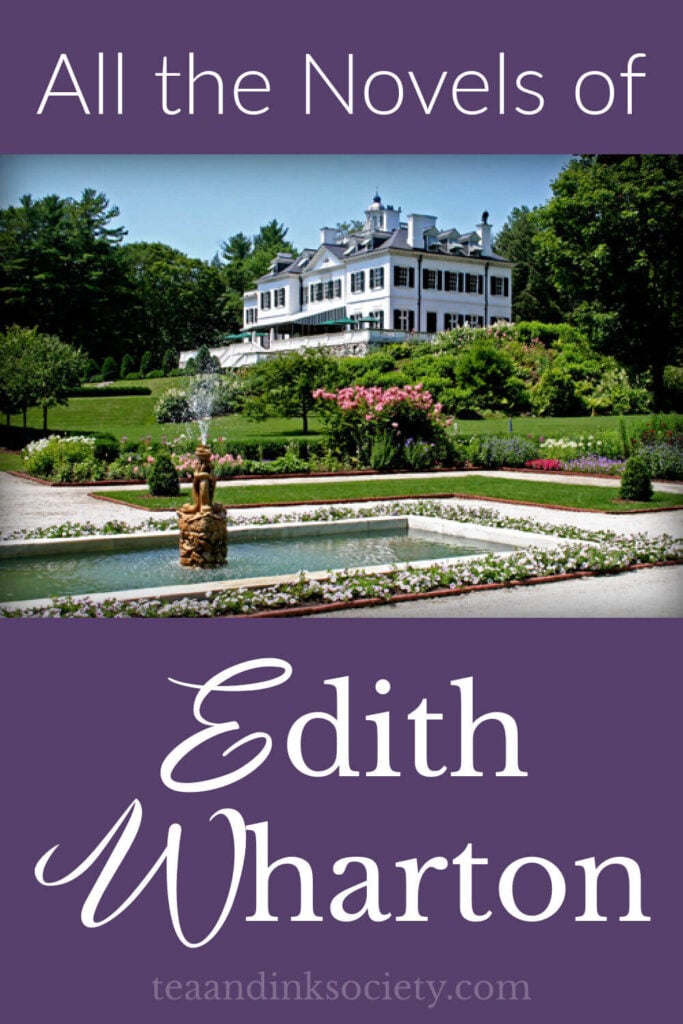
Note: The top image in this post shows The Mount in Lenox, Massachusetts, the home Edith Wharton shared with her husband Teddy, which she designed and landscaped herself. You can still visit it today.

Very interesting! There’s some background here on Wharton’s life that I wasn’t aware of before, like her war work.
I was planning on reading Old New York, but Glimpses of the Moon looks intriguing too; I’m not at all familiar with that one.
I know, it is wild to think of her being in Paris during WWI with that very real threat of invasion. She could’ve so easily gone back to the States, but she stayed put.
Since I’m getting a kind of late start in this month’s reading I’m going for a shorter option – Summer. I read Age of Innocence as my March classic from the library.
You’ll fly through it! It’s so good! I was sad that Charity didn’t appreciate books more, though. That hurts, for a heroine to *not* like to read!! Let us know what you think when you’re finished!
I tried reading for the first time Edith Wharton by starting with “The Buccaneers”, however I could not get through it, I wasn’t enjoying it. Do you have any other recommendation of her? I really want to read Wharton, I’ve heard wonders of her novels. Thanks!!
I would start with Old New York, since those are short novellas that will give you a taste of classic Wharton without having too many details or characters to bog you down. Another recommendation would be to read Summer; it’s very “fast paced” and easy to read. But it might also be helpful to know what specifically you didn’t care for about The Buccaneers, as that might help me or other commenters to give you better advice on what to try instead!
This is so helpful! She sounds like a fascinating person even apart from her novels. I’ve read six of her novels and novellas, so lots more to go. I’d like to get to the WWI novels this year.
Yes, I find her absolutely fascinating! I hope I get to visit The Mount someday. I feel like seeing a place she put so much effort and creativity into would tell me a lot about her.
I read The Age of Innocence for the reading challenge, and then on a whim, got the e-book from my library for Glimpses of the Moon. I enjoyed it thoroughly! I felt like it actually had a bit of a “happy ending” which doesn’t always seem to be the case for Wharton’s books.
Indeed! Thomas Hardy is another whose known for his tragic endings, but I was pleasantly surprised by the endings of Far from the Madding Crowd (happy after much pain), and Under the Greenwood Tree (just plain happy, but with a little zing in the last line). I love Wharton and Hardy, but I’m always nervous if people whom I recommend their books to will feel a little “betrayed” by the sad endings, ha!